Bally Blacksmith & Metal Shop and the Chestnut Trees
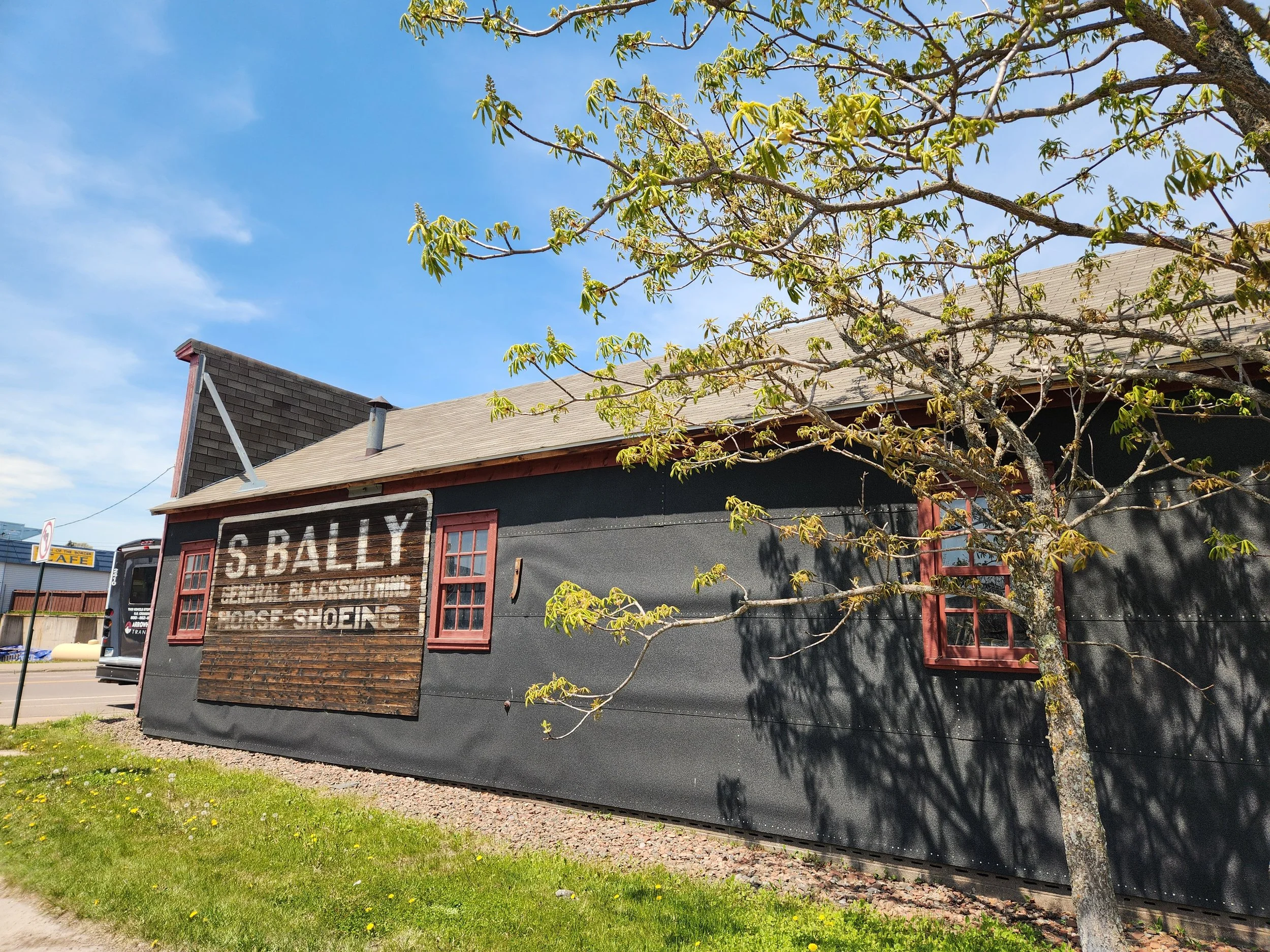
Bally Blacksmith & Metal Shop with the horse chestnut trees
Outside the Bally Blacksmith & Metal Shop in downtown Grand Marais sit chestnut trees, specifically, horse chestnuts. The trees, which are not native to Minnesota, were planted in the 1970s by the Historical Society as a historical connection to chestnut tree lore and, most specifically, the poem, "The Village Blacksmith," written and published by Henry Wadsworth Longfellow in 1840 (see the full poem via the link below).
In the poem, the village blacksmith is described as a man of "large and sinewy hands" whose honest sweat and independent spirit make him a pillar of the village, as he stands under a "spreading chestnut tree." In the years after "The Village Blacksmith" was published, it was not uncommon to see chestnut trees around blacksmith shops.
In other chestnut folklore, the tree was woven deeply into Appalachian culture, with it being described as the “cradle to grave tree,” due to its versatile wood that saw a person through their life, from a wooden cradle to a coffin.
In Celtic folklore, the chestnut tree is a symbol of "providing" and "guardianship."
While the tree is not native to Minnesota, there is no specific Ojibwe name for the horse chestnut. However, according to the American Chestnut Society, the name for the general chestnut is Gichi-zhaawemin, or Kitchijawemin.
This weekend, the Bally Blacksmith and Metal Shop will begin summer hours, opening regularly on Saturdays and Sundays from 12 p.m. to 4 p.m. Trained, interpretive staff will be on site to share stories, answer questions, or give short tours.
The Village Blacksmith
By Henry Wadsworth Longfellow, 1807 –1882
Under a spreading chestnut-tree
The village smithy stands;
The smith, a mighty man is he,
With large and sinewy hands,
And the muscles of his brawny arms
Are strong as iron bands.
His hair is crisp, and black, and long;
His face is like the tan;
His brow is wet with honest sweat,
He earns whate’er he can,
And looks the whole world in the face,
For he owes not any man.
Week in, week out, from morn till night,
You can hear his bellows blow;
You can hear him swing his heavy sledge,
With measured beat and slow,
Like a sexton ringing the village bell,
When the evening sun is low.
And children coming home from school
Look in at the open door;
They love to see the flaming forge,
And hear the bellows roar,
And catch the burning sparks that fly
Like chaff from a threshing-floor.
He goes on Sunday to the church,
And sits among his boys;
He hears the parson pray and preach,
He hears his daughter’s voice
Singing in the village choir,
And it makes his heart rejoice.
It sounds to him like her mother’s voice
Singing in Paradise!
He needs must think of her once more,
How in the grave she lies;
And with his hard, rough hand he wipes
A tear out of his eyes.
Toiling,—rejoicing,—sorrowing,
Onward through life he goes;
Each morning sees some task begin,
Each evening sees it close;
Something attempted, something done,
Has earned a night’s repose.
Thanks, thanks to thee, my worthy friend,
For the lesson thou hast taught!
Thus at the flaming forge of life
Our fortunes must be wrought;
Thus on its sounding anvil shaped
Each burning deed and thought.
This poem is in the public domain.
Posted June 3, 2026