My mother myself; my mother herself
by Corinne Michel Grand Marais, MN
Originally published in the summer 1981 issue of Women’s Times.
I have not been an ideal daughter. Well sometimes I have been; but, yes, it's true, I had times of anger and complaint, of hostile irritation toward my mother. As a mother myself I gave love and concerned understanding to my own daughters. Yet I know perfectly well that they remember the occasions when I was bitchy, domineering and judgmental. Their own sweetness often changed to sulking and rebellion.
There it is. Mother’s Days come to our generations with the sentimentality of love and the cynicism of frustration. I am between it all, daughter to an octogenarian, mother to new and liberated women. My own aging forces me to look ahead as I bask in my present. I am without choice. There is not much point to do more than remember my own youth and envy, just a little, the present richness of my daughters’ lives.
The now moment of my mother’s reality overwhelms me. Her days are dwindling to those precious few, while my daughters and I may live into the next century. What I share with my mother seems to be suspended time. Our differences have become unimportant. Our relationship is simplified, yet it shifts in depths depending on my mother’s well being. The firm confidence of the mother who dealt with my clumsiness, inattentions, arguments and verbal resentments has become a fragile bulwark for dealing now with her own survival. For her, as well as myself, these past conflicts are of no consequence. I have become the welcome intrusion into the long silence of the passing days.
There is a poignant reward for me in the intensity of her pleasure when she greets me at her door. She draws me into the living room, and I know I will listen part of the time to several repetitions of the echoes of old stories I’ve heard all my life. The familiar pattern of worn and tattered words now reminds me of her early gift to me when I returned home from school. She listened patiently as I prattled on and on, hardly able to gulp the milk and toast she had set before me. Now, being grown up, I receive coffee, and the virtue of listening is mine. I am quieter and am learning patience.
Of course, though some things change, nothing changes. My mother must still listen. I need an interested audience when I speak of my children’s lives. My mother and I are mothers and grandmothers. And she is the greatgrandmother. We are the universal woman, not unique in any way. We remember the various children in our family, their births, the colic, the ways of their growth, our intrigue with their cuteness and funny behavior, all progressing to graduations, marriages and new births. Then my mother is not the only repeater. Happily she forgets what she hears rather quickly, and my repetitions are received as new chapters of our old tales.
My mother is still the self sufficient person I’ve always known. She needs little from me that is not already provided for. Except to get a bath. Who should bathe her? Her son? An outsider? This help is trusted to a daughter. The bathtub is a challenge, a risk. Just plain tricky for old legs and a head that gets dizzy from sudden movements. She and I have had to learn to manage the cooperation needed for this task. Once she managed a playful child in a galvanized tub on long ago Saturday nights. She is more considerate than I had been, as she perches on a stool and I am on my knees. There is no splashing or demanding to linger in the small pool of water. She lets me wash her hair and closes her eyes as soapy water flushes down her head. The wrinkled satin of her skin, its looseness and folds have softness to my touch. She chooses, quite properly, to herself cleanse the area that confirms her womanhood. When her bath is complete, she rises slowly, clutching the towel bars, moving with old grace. She is quietly poised as I dry her hair, but prefers to towel her body herself. From a confusion of jars, I find a fancy amber bottle of body conditioning cream. My hands smooth the lotion on her back, her arms, her legs, her red and swollen feet.
As I clean the tub and hang the towels, she dresses herself. She puts her glasses on to find a lacy nylon chemise and slip in her drawer. After the under garments have been slowly put on, she peers into her closet, trying to match the blue of a flowered blouse with a skirt.
The ceremony of bath and dress has not been a silent event. My mother chooses humor to conceal her dismay at the changes of the years. My responding humor admires her vigor as I support her. Accepting the absolute of the passing years has left both of us vulnerable. Our fading is a matter of degree, and we are empathetic about what our eyes behold.
Hair setting is a welcome shift. We choose to talk of other matters such as her early experience as a lady’s maid, tending the coiffeur of a steel magnate’s wife. She sits erect in her kitchen as her hair is rolled into orderly patterns. In the living room she rests in her rocker while warm air is blown into the pink plastic bonnet puffed up above the curls. Her eyes close while I gather up the tools of beautification. I read until it is time to comb out the thinning hair.
Whatever was it that used to set us on edge? Why did we choose to express our irritations in sullenness or sudden diatribes? I shrug the questions away. These problems seem to have dissipated.
When my mother has combed her hair she is pleased with what the mirror reveals. I too admire her. She is lovely, only partly because my hands have touched her. I see that she has endured with strength and grace. My own aging draws me into her experience. We drink coffee, enjoying being together. Our past cannot be undone. What time will be left to us? This morning must be treasured by my mother, by myself. If this should be all there is, it is everything. It is enough.
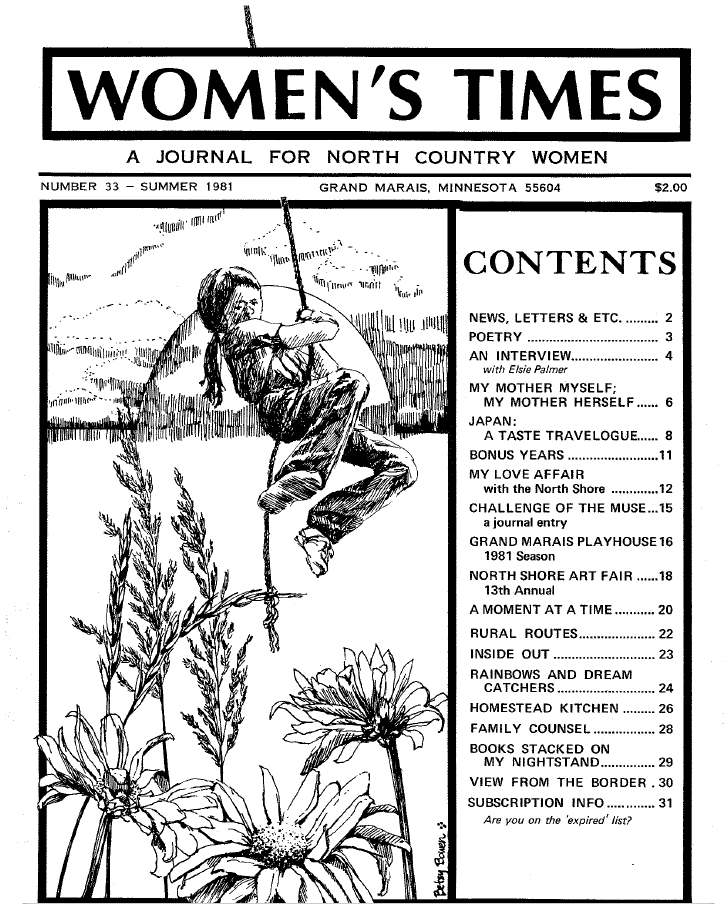
"Women's Times" was a publication launched in the late 70s by Carolyn Sanford and Jane Lind, both of whom lived in Cook County at the time, to "stimulate women to read, to discuss, to think, to contribute" (Issue 1, February 1978).
Each issue contains articles from local contributors on specific topics that affected women during that time.